
Seasonal Outlook for the 2026 ACT grass pollen season
Sept. 8, 2026
The ACT is entering spring after a wetter and warmer than average winter, but the balance of evidence points to a less active grass pollen season than last year.
Rainfall was above average at every Bureau of Meteorology monitoring site across the Territory, and Canberra Airport recorded 137.8 mm during winter, 110% of its long-term average. These conditions have provided enough moisture for grasses to begin growing.
However, the latest maps show that root-zone soil moisture around Canberra is now generally close to average, rather than above average as it was at the same time last year. Satellite imagery also shows slightly less green growth around Canberra and the surrounding Southern Tablelands than in early September 2025.
The Bureau continues to forecast a warm and dry start to spring. If soil moisture is drawn down quickly during September, grasses may stop growing or flower less fully, reducing the amount of pollen produced. If moisture persists into October, or useful rain arrives, Canberra could still experience periods of high or extreme pollen. On balance, a repeat of last year’s particularly active season appears less likely.
Setting the Scene: How 2025 Played Out
The 2025 grass pollen season was particularly active in Canberra. Between October and December, Canberra recorded 14 extreme, 28 high and 28 moderate grass pollen days. In total, grass pollen reached at least moderate levels on 70 days, including 42 days in the high or extreme ranges.
This sets a high benchmark for 2026. Last year, above-average soil moisture and strong vegetation growth provided favourable conditions for grasses to continue growing and flowering through spring.
Winter 2026 still provided a reasonable foundation for early growth. Rainfall totals were above average at all ACT sites and ranged from around 110% to 127% of average. Canberra Airport recorded 137.8 mm of rain, while its mean daytime and overnight temperatures were 1.1 °C and 0.9 °C above average. The combination of rain and unusual warmth helped grasses establish, but the latest soil-moisture and vegetation data show that the current starting point is not as strong as it was before the 2025 season.
Soil Moisture Conditions
Soil moisture plays a critical role in determining how much grass pollen ends up in the air. When soils are moist, grasses grow vigorously, develop more leaves and stems, flower fully, and release large amounts of pollen. When soils dry too early, growth slows and pollen production can be reduced.
As Figure 1 shows, root-zone soil moisture across the ACT on 5 September 2026 is generally close to average. This is not a particularly dry starting point, but it is lower than at the same time last year, when broad areas around Canberra had above-average soil moisture.
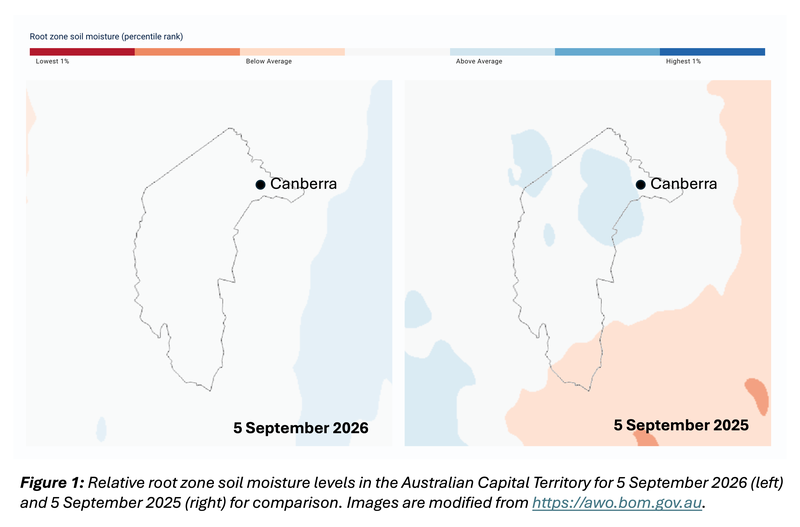
The above-average winter rainfall replenished the soil and should support early spring growth. However, it has not left the same broad reserve of above-average moisture that was present in September 2025. If rainfall remains limited and temperatures rise quickly, the available moisture could be drawn down before grasses complete their main growth and flowering period.
If soils remain moist through September and into October, grasses may still have enough time to develop and flower. The timing of the expected drying will therefore be critical to the size and duration of the season.
Vegetation Greenness and Growth Potential
Satellite imagery showing vegetation greenness, known as the Enhanced Vegetation Index or EVI, indicates that vegetation around Canberra and the surrounding Southern Tablelands is broadly similar to, but slightly less green than, it was at the same time last year (Figure 2).
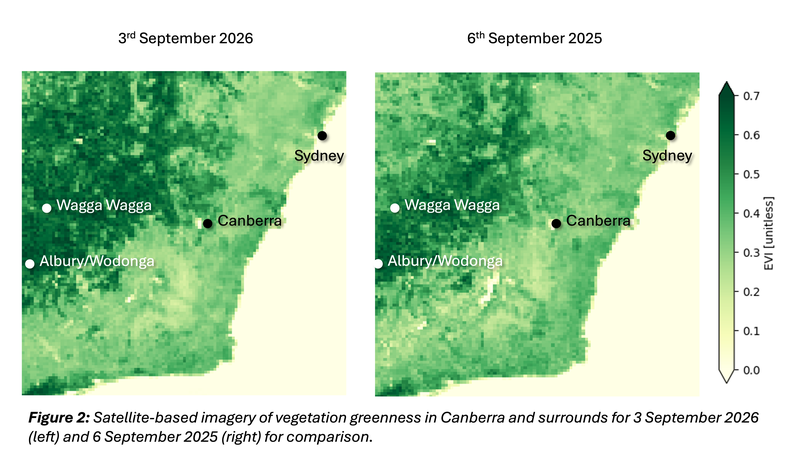
The broader region to the west and north-west of Canberra shows stronger green growth in some areas, but the immediate Canberra region does not show a clear increase in vegetation compared with early September 2025.
This difference is important because vegetation greenness provides an indication of how much actively growing plant material is present across the landscape. The latest imagery suggests there is no large increase in the amount of biomass available to produce pollen around Canberra compared with last year.
There is still active vegetation growth across the region, and grasses can respond quickly if useful rainfall arrives. However, if the landscape dries during September, some of the current growth may stop before grasses have flowered fully.
Climate Drivers and the Rainfall Outlook
A strong El Niño is now established and is expected to intensify further through spring. El Niño is a warming pattern in the tropical Pacific Ocean that often shifts the odds towards drier spring conditions across eastern Australia.
The Indian Ocean Dipole, a climate pattern in the tropical Indian Ocean that can also influence rainfall across south-eastern Australia, remains neutral. Bureau models continue to suggest that it could become positive during spring, although the predicted strength of any event has decreased in recent forecasts.
These broad climate drivers provide useful background, but the Bureau’s local rainfall and temperature outlook gives the clearest indication of what is expected across the ACT (Figure 3).
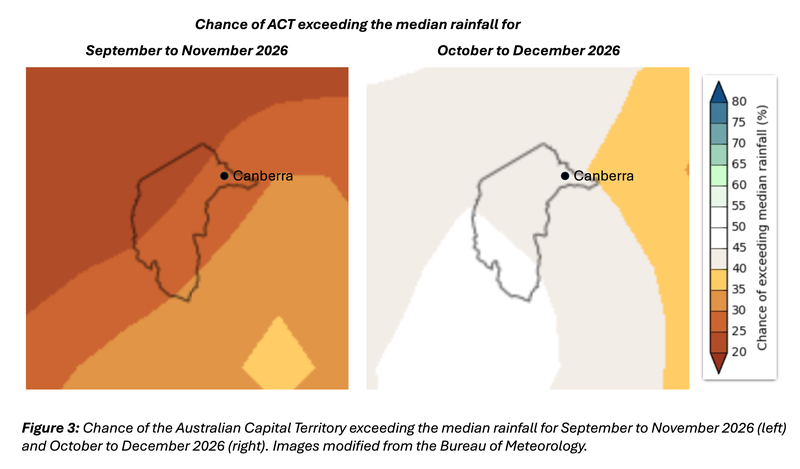
For September to November, the chance of exceeding median rainfall is generally around 20% to 35% across the ACT. This is a strong dry signal during the period when grasses would normally be building biomass and beginning to flower.
The outlook becomes much closer to neutral for October to December, when the chance of exceeding median rainfall moves towards 45% to 50% across much of the Territory. This means useful rain later in spring remains possible, but it may arrive after the most important period for early grass growth.
Daytime and night-time temperatures are also likely to be above average. If warmer conditions arrive early, soils and vegetation may dry quickly during September.
What This Means for the Season Ahead
The current outlook suggests that Canberra’s 2026 grass pollen season is likely to be less active than last year’s particularly active season. Current soil moisture is generally around average, vegetation around Canberra is slightly less green, and the Bureau is forecasting a warm and dry start to spring.
If the dry conditions arrive early and remain in place, grass growth and flowering may be cut short. Under this pattern, Canberra would be likely to experience fewer high and extreme grass pollen days than it did in 2025, and the main season may also finish earlier.
However, a drier outlook does not guarantee a mild season. The ACT received above-average winter rainfall, and there is enough moisture to support early growth. If that moisture carries grasses through September and into flowering, or if useful rainfall arrives during early spring, Canberra could still experience periods of high or extreme grass pollen during October and November.
Warm, dry and windy weather can also help release and transport pollen once grasses have flowered. The timing of the warmer conditions is therefore critical. Early heat may limit how much pollen is produced, while warmer weather after flowering can contribute to high pollen levels in the air.
Last year’s 43 high or extreme grass pollen days set a very high benchmark. A less active season in 2026 would not mean that every day will be low, or that people with hay fever and asthma will not experience challenging periods.
- “Last year set a very high benchmark, and the balance of evidence points to a less active grass pollen season in Canberra this year,” said Dr Edwin Lampugnani, CEO of AirHealth, operator of the Canberra Pollen service.
- “Canberra had a wetter and warmer than average winter, so grasses have had enough moisture to begin growing. However, soil moisture is now mostly around average, and the Bureau is forecasting a dry start to spring.”
- “The timing will decide the season. If soils dry during September, Canberra should see fewer high and extreme pollen days than in 2025. If moisture lasts into October, there could still be sharp increases once grasses flower.”
How to Prepare
Although the overall season is expected to be less active than last year, individual high and extreme pollen days can still significantly affect people with hay fever or asthma. Preparation remains important because pollen levels can change quickly with changes in temperature, wind and rainfall.
- “Pollen season is a good reminder to check in on your asthma. Make sure your medicines are right for you, your inhaler technique is correct and your written Asthma Action Plan is up to date. A review with your doctor can help identify problems before they become an emergency,” said Kate Miranda, CEO, Asthma Australia.
To prepare for the weeks ahead:
- * Talk to your GP or pharmacist about managing hay fever or asthma symptoms before grass pollen levels begin to rise.
- * If you have asthma, or care for someone who does, make sure your written Asthma Action Plan is current.
- * Ensure your medications are up to date and carry them with you during the pollen season.
- * Visit the ACT Government pollen information page for more information.
Where to find out information about Pollen counts and forecasts?
The best way to stay informed about how much pollen is in our shared air is to visit the Canberra Pollen website or download the Canberra Pollen App, available from the Apple App Store and Google Play. The service provides daily grass pollen counts and forecasts, push notifications and information to help people plan their activities during the grass pollen season. Checking forecasts can be helpful, even if the overall season is expected to be less active as high and extreme pollen days can still occur. You can still have asthma or hay fever symptoms even if the pollen level forecasts are low.
The Bottom Line
The 2026 ACT grass pollen season is likely to be less active than last year’s particularly active season. The ACT experienced a wetter and warmer than average winter, which has supported a reasonable start to grass growth. However, root-zone soil moisture is now generally close to average rather than above average, and satellite imagery shows slightly less green growth around Canberra than at the same time last year.
The main uncertainty is how quickly the landscape dries. If warmer and drier conditions arrive early during September, grasses may produce less biomass and flower less extensively, resulting in fewer high and extreme pollen days and a shorter season.
If soil moisture lasts through September and into flowering, or if useful rainfall arrives during early spring, Canberra could still experience periods of significant grass pollen during October and November. A repeat of the very active 2025 season appears less likely, but people with hay fever and asthma should continue to prepare and check daily forecasts throughout spring.


© 2010- AirHealth Pty Ltd and Australian National University. All rights reserved.
This information is copyrighted (Terms & conditions). Apart from any use as permitted under the Copyright Act 1968, no part may be reproduced by any process without prior written permission. This includes all pollen information and forecasts.